
Because I am old, at least in Internet years, I reminisce a lot about the better days. A comment like that normally sparks the ‘You’re wearing rose-tinted glasses’ argument, but it’s hard to argue that the early Internet was, on the whole, worse than the modern Internet. The only valid complains I can come up with are the speed, the fact that you couldn’t use the telephone when surfing the web, and that Yahoo had no problem throttling content of high-trafficked (and thus popular and lucrative) Geocities pages to make a few extra pennies when finding a way to monetize the traffic would’ve been a smarter solution. There’s probably more I’m missing, but again, I’m old, and that’s my blanket cop-out for not giving a good argument; eat it.
My advanced digital age has also afforded me the ability to remember pre-advertisement Internet, which was the best part. The web was nice and quiet, and even when banner ads started to become popular, it was still nice and fuckin’ quiet. Then came the pop-ups, the hover-overs, the forced audio, the pop-under, the scripts, the moving windows, the timed redirects, and just about everything we see today. My idiot friend once bricked a family machine when he fell for that one that’s designed to look like Windows XP Explorer and tells you you’re system is flooded with viruses. Nice doing, dumb-ass.
That experience is why I pay to not put ads on this place, and, if I ever get my act together and stop being lazy, I’ll actively encourage viewers of my video content to use ad-block. If we still existed in the era of proper banner ads that opened new windows to take you to their links and didn’t have the high probability of injecting dangerous scripts into your machine on use as a result of shit-house advertising companies contracting out programming work to people who don’t know/don’t care about the purpose of the job and thus make snooping software all willy-nilly, then hell yeah, I’d employ banner ads. At that point, I’m just an online mall that provides you with my content, and if you want to take a break from reading/listening to me to go buy a shirt, that’s all you. However, like I said, that’s not a guarantee, and the worst part is that to even be able to solidify such a schema would require someone to already have an audience that’s sizable and monetizable in some way, and at that point, why not just plug for direct donations via PayPal/Paypal.me/Patreon? Those are much better middle-men who earn money when you earn money, and not those who earn money via clicks, so you have much more leverage to use against them to create favorable terms, and they have more incentive to let you keep on keeping on.
I guess a nice way to sum it up is that while I don’t mind the concept of advertising, I hate the modern execution. I hate that I have to use ad-block, which takes up resources on my computer, to keep my browsing optimal. I hate that pages are designed with ad-space in mind now, and that advertisements on video platforms have no restriction. That’s why, until recently, television was a more tolerable medium. You knew in every hour you’d get about four to six adverts, at least here in the US, at a minimum of two per show. That’s one every twelve to fifteen minutes or so, and they last long enough to ignore or go do something else in the time period. Now, television networks are abusing micro-ads and Picture-in-Picture ads, which were popularized on YouTube, and video content, like I said, doesn’t restrict ad length, so you can get a two-minute video with a seven minute ad, which is typically click-bait garbage made by a click-bait garbage YouTuber. This invasive, wanton sell-sword shit is what grates my cheese, and to add on to the shit-heap, organizations are now complaining about things they would’ve understood had they read the fine fuckin’ print of the contract they signed when they sold their souls.
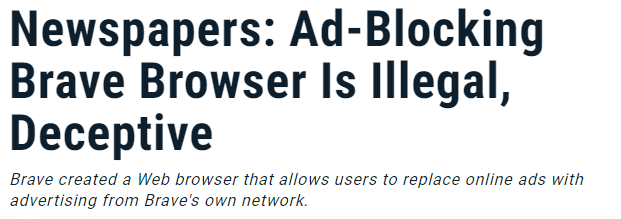
Deep breath: No.
Websites that host advertisements do not, in general, work directly with companies that have products to sell. They, instead, work with middle-men companies that recruit websites to sell space to them so that this middle-man organization can places ads onto the website. This means that neither the business desiring advertisements nor the website owner has control over what actual ads go up; they’re trusting the ad agency to do the right thing and not use advertisements that put them at risk. Yes, most ad agencies don’t do this, because it means lost customers, but again, there’s minimal to no client control, and what’s to stop an agency from using unscrupulous means to do their job and then pass the blame onto something or someone else? It’s a hypothetical, sure, but with millions of advertising agencies out there, it’d be illogical to assume people are all good-natured and wouldn’t do that.
Regardless, the point is that website sell ad-space, and whatever goes up there goes up there. If Brave decided to make complete copies of the ads and then tie them directly to their digital coin system, would this have even been caught? Keep in mind, I don’t know Internet advertising law and regulations in regards to the specifics & details. It’s certainly an under-handed maneuver, but considering how little I’ve come across in regards to how online advertisement works now aside from the fundamentals that were established decades ago, I don’t see the illegality directly, especially since a browser developer, I believe, has every right to rearrange how content is shown/viewed on their window to the Internet. If they don’t, then they need to contact Google/Alphabet and tell them to stop curating searches to provide biased results.
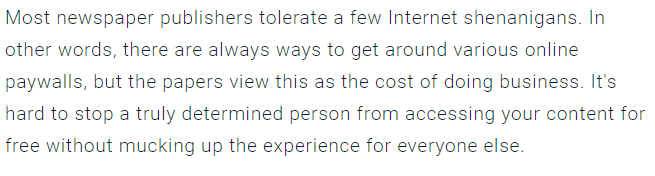
What pages, where?
Most big name news publishers (i.e. the only ones that matter when it comes to setting precedents) employ means to stop people from viewing their content just to sell ad-space and allow unchecked scripts to run during the reader’s time at the article. Lots of scripts scrape data in silent about the reader, and it’s all done to ‘sell ads better’ or ‘improve user quality of life’, whatever that means because no advertisement agency has ever come out and explained their predatory tactics, likely because nobody would buy their bullshit. Note that this includes really well-written articles that could sell on the strength of the piece alone, so places like the New York Times or Forbes are actively gutting their own content and its quality just to make pennies from data scrapers pilfering your digital coffers. Stop for a second and ask yourself, ‘Does that even make sense?’ It shouldn’t, because who would actively stop organic and natural growth, things that were highly desired in regards to their content, to ensure some blank faces get their cut, too? An idiot, that’s who.
The only reason these papers view people who are capable of reverse-engineering a page displaying an article in such a way they can read it without invasive ads & scripts as a ‘cost of doing business’ is because these organizations are run by moronic old-hats who don’t grasp that they would stand to make more through clicks, versus the ‘promise’ of making even more (whatever that amounts to) through data scraping via highly questionable and possibly illegal means. Again, these people are doing all of this for a few extra pennies out of each person. Yeah, that adds up to millions over millions of people, but at some point we will know everything about everyone (see: China’s shit-house people-rating point system) and can’t scrape anymore, or people will start checking out in droves thanks to Word-of Mouth from peers and others regarding using non-invasive products. What do you do then? What do you do when you meat the one organization or individual who will not sell out, or will only do it for a purposefully ludicrous price that puts everything in their favor, and leaves you out in the cold? Is there any forethought?
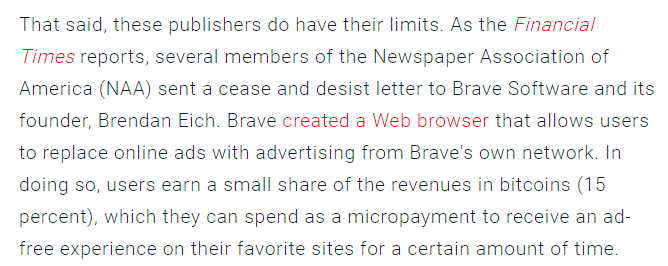
So, Perk if Perk wasn’t straight garbage.
Again, I can’t speak on the complete legality of all this, I can only speak at the very superficial/foundational level, and to me, it seems like a big case of fuckin’ sour grapes. I didn’t even know there was a Newspaper Association of America, considering that actual newspapers are a quaint and wonderful relic of a distant past that, if these shit-house news companies went back to providing, I would happily pay for; I’d rather have weekly cheap firestarting material than have to do a cost-benefit on whether burning my machine to achieve the same means is worth it. It’s also not even known as the NAA anymore, but rather the News Media Alliance (NMA), which sounds way more skeevy to me considering how anything that is an alliance and not tied to Warcraft these days tends to be filled with butthurt, try-harding losers who can’t take a loss and have no issue invading your life to push their beliefs onto you; heck, reading the new acronym out loud even sounds like ‘enemy’/’enema’, and that last thing I want to associate with is induced shittery. I also learned that there is a National Newspaper Association, which is and does exactly what I thought the would do, i.e. selling and trading actual newspapers. Perhaps this NNA is also shady, but they have a really low-budget website that doesn’t seem to have any pretense, so they get a thumps-up from me for being endearing. Jesus Christmas Christ, am I really comparing newspaper organizations here?
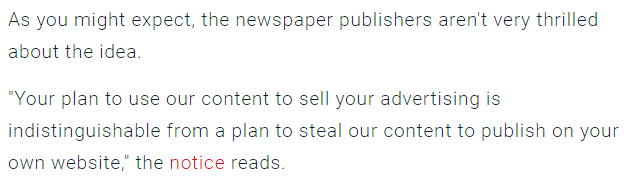
Sour fuckin’ grapes.
You know, they might have had an actual case if it was, ‘We signed this space over to X, and here you, Y, come and use it without our permission on our domain. Not cool, and we’ll see you in court.’ Instead, it’s ‘YOU STOLE OUR ADS, SO THAT’S LIKE STEALING ALL OUR CONTENT. IT DOESN’T MATTER THAT I STILL SEE MY CONTENT ON YOUR PAGE OR THAT I DON’T OWN THE ADS AND AM SIMPLY LEASING OUT THE SPACE! YOU ARE STEALING WHAT IS MINE YOU BIG MEANIE’, which seems like a response just about anyone listening to is going to be unreceptive to. Also, it’s a web browser. It’s a tool that functions as a window/gateway to the Internet, just like a television functions as a gateway/window to cable content, or a library functions as a gateway/window to printed content. The fact that the NMA doesn’t get this is fairly evident proof they have no idea how the Internet works and, thus, should be the last people bitching about fairness on it.
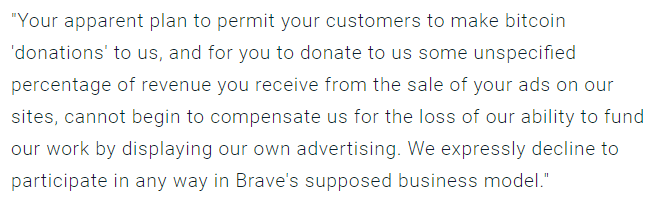
Show me the line items, sir.
From the very little I know of ad space on YouTube and video platforms, the foundational unit is CPM, or Cost per Mille, which is a permutation of how professional transportation services use a Cost per Mile rate for their drivers (or not, whatever). It breaks down to a cent value per mile traveled, and for media, a cent value per thousand views. This, of course, alters varying on whether or not people actually view the whole ads, or click them, with longer watch times being able to earn a content creator more, and clicks being the most lucrative. Since ads on YouTube, Twich, and Blip (when it was alive) were modeled after both television and old web ads, it’s not unreasonable to make the claim that how those ads function as a monetary vehicle is similar to typical block, pop-up, and banner ads. Thus, as I’ve stated multiple times so far, these companies are making pennies per view, if that; it just so happens that when thousands to millions of faceless clicks come to your page, that makes lots of dough over an infinite amount of time since the digital landscape never goes away.
It’s important to note that all of this is with a model that the vast majority of web denizens don’t want, for the host of reasons I’ve already stated. Brave’s model, on the other hand, is opt-in and client-facing, meaning you don’t have to participate if you have no desire, and the user gets full control of where the cash is going. This means that if the New York Times is a beloved website of a user, he/she can watch Brave’s ads on the NYT’s pages, then directly give that digital coin money equivalent to the NYT directly, a value which, since digital coins have a finite amount and take effort to discover, is likely going to be worth more dollars in the long run. The short of it is that it makes little sense for the NMA to push for using a detested model when they could’ve either made a better argument based on established contract precedents and contract law, or just shut the fuck up and profited off of it in silence. Whining and not offering a better solution is stupid.
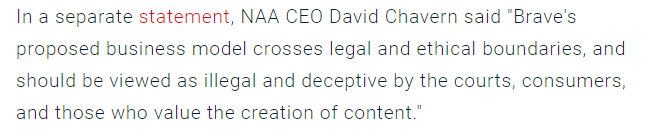
Being half right doesn’t equal full right.
Even though it’s highly questionable in practice, I still love it because I actively pay to not have poorly constructed advertisements on my page, so if whatever exists/were to exist of my fan-base decided to opt-in with Brave, they would be watching ads I never put up and then paying me money to do so. Seriously, what kind of dipshit would I have to be to form a hate-boner for people consuming my content and willfully putting themselves through a more arduous experience and then paying me for how they used their time? I grasp this sounds like selling out, but it’s not because it’s all predicated around user decision and control; there isn’t any paper I’ve signed to make this stuff happen. Maybe there will be something creators have to sign with Brave, but even then, I’ll continue to not host ads here, because I value the notion of having at least some place where people are fucking scraping the digital scum off a reader’s pixel boot in the hopes of selling them a pot of coffee somewhere.
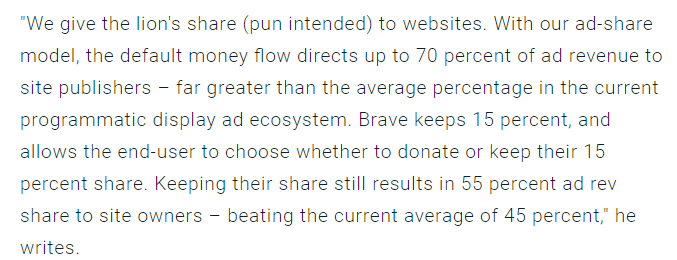
Well, that seems reasonable.
I wish I knew more about online advertising and how advertising works in general in relation to selling space/old-school billboard practices, because if this is true, then it’s one more nail in the coffin against the NMA’s argument. Not that it was a good argument to begin with, mind you, just that there could’ve been legal ramifications based on established contracts which, and I’m being a broken record here, should’ve been the initial argument and not ‘YOU’RE TAKING MAH MONEY EVEN IF I DON’T GET HOW ANY OF IT WORKS’.
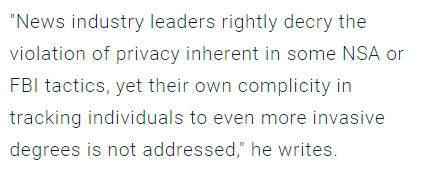
Insert head nod here.
I’ll end it with this, mostly because there’s nothing more to the article, but also because this factoid was the reason I chose to write this, and is the core reason of most of the shit I put up here and bitch about. I would have never even considered penning this if the NMA had said they were salty as fuck and were going to try and find some legal recourse about this if it were a possibility. That’s a completely understandable take, and I’m sure there’s something somewhere that Brave is doing through this that is in violation of an existing statute or codified law. However, the NMA did not take that position and, instead, came in with emotional cannons blazing, hoping to scare the development team into submission, and is now floundering because they were told to go pound some fuckin’ sand.
I don’t know if I’ll opt into Brave’s system because it defeats the purpose of using a browser that blocks all the malicious nonsense that goes uncontrolled on the web, and it seems like a ‘too good to be true’ situation that is one poor decision away from being a reskin of what we currently have. Despite my concerns, I appreciate the honesty and transparency that the Brave team is employing, and that they aren’t just willing to stand their ground, but also call out the blatant hypocrisy that modern news media outlets hide behind. Being hypocritical is already shitty, but being knowingly hypocritical is lying and calling it something else. That’s noise I don’t want to hear, so miss me hard with that shit.
 The Sahlt Factory